

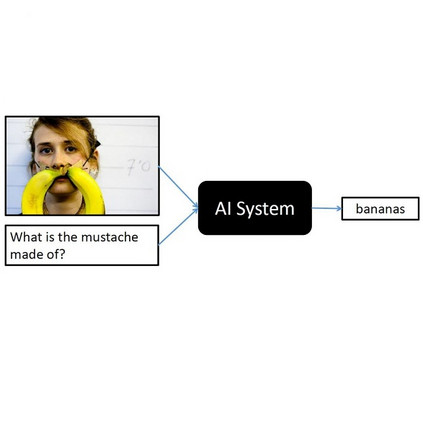
To increase the generalization capability of VQA systems, many recent studies have tried to de-bias spurious language or vision associations that shortcut the question or image to the answer. Despite these efforts, the literature fails to address the confounding effect of vision and language simultaneously. As a result, when they reduce bias learned from one modality, they usually increase bias from the other. In this paper, we first model a confounding effect that causes language and vision bias simultaneously, then propose a counterfactual inference to remove the influence of this effect. The model trained in this strategy can concurrently and efficiently reduce vision and language bias. To the best of our knowledge, this is the first work to reduce biases resulting from confounding effects of vision and language in VQA, leveraging causal explain-away relations. We accompany our method with an explain-away strategy, pushing the accuracy of the questions with numerical answers results compared to existing methods that have been an open problem. The proposed method outperforms the state-of-the-art methods in VQA-CP v2 datasets.
翻译:暂无翻译




相关内容



 微信扫码咨询专知VIP会员