

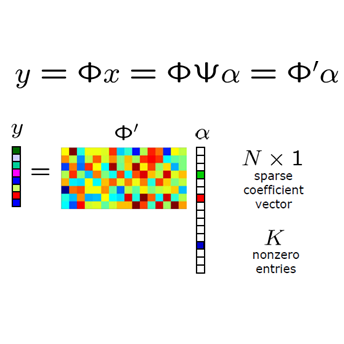
Popular social media platforms employ neural network based image moderation engines to classify images uploaded on them as having potentially objectionable content. Such moderation engines must answer a large number of queries with heavy computational cost, even though the actual number of images with objectionable content is usually a tiny fraction. Inspired by recent work on Neural Group Testing, we propose an approach which exploits this fact to reduce the overall computational cost of such engines using the technique of Compressed Sensing (CS). We present the quantitative matrix-pooled neural network (QMPNN), which takes as input $n$ images, and a $m \times n$ binary pooling matrix with $m < n$, whose rows indicate $m$ pools of images i.e. selections of $r$ images out of $n$. The QMPNN efficiently outputs the product of this matrix with the unknown sparse binary vector indicating whether each image is objectionable or not, i.e. it outputs the number of objectionable images in each pool. For suitable matrices, this is decoded using CS decoding algorithms to predict which images were objectionable. The computational cost of running the QMPNN and the CS algorithms is significantly lower than the cost of using a neural network with the same number of parameters separately on each image to classify the images, which we demonstrate via extensive experiments. Our technique is inherently resilient to moderate levels of errors in the prediction from the QMPNN. Furthermore, we present pooled deep outlier detection, which brings CS and group testing techniques to deep outlier detection, to provide for the case when the objectionable images do not belong to a set of pre-defined classes. This technique enables efficient automated moderation of off-topic images shared on topical forums dedicated to sharing images of a certain single class, many of which are currently human-moderated.
翻译:暂无翻译




相关内容




 微信扫码咨询专知VIP会员