

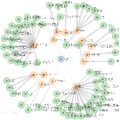
Recent years have witnessed the prosperity of knowledge graph based recommendation system (KGRS), which enriches the representation of users, items, and entities by structural knowledge with striking improvement. Nevertheless, its unaffordable computational cost still limits researchers from exploring more sophisticated models. We observe that the bottleneck for training efficiency arises from the knowledge graph, which is plagued by the well-known issue of knowledge explosion. Recently, some works have attempted to slim the inflated KG via summarization techniques. However, these summarized nodes may ignore the collaborative signals and deviate from the facts that nodes in knowledge graph represent symbolic abstractions of entities from the real-world. To this end, in this paper, we propose a novel approach called KGTrimmer for knowledge graph pruning tailored for recommendation, to remove the unessential nodes while minimizing performance degradation. Specifically, we design an importance evaluator from a dual-view perspective. For the collective view, we embrace the idea of collective intelligence by extracting community consensus based on abundant collaborative signals, i.e. nodes are considered important if they attract attention of numerous users. For the holistic view, we learn a global mask to identify the valueless nodes from their inherent properties or overall popularity. Next, we build an end-to-end importance-aware graph neural network, which injects filtered knowledge to enhance the distillation of valuable user-item collaborative signals. Ultimately, we generate a pruned knowledge graph with lightweight, stable, and robust properties to facilitate the following-up recommendation task. Extensive experiments are conducted on three publicly available datasets to prove the effectiveness and generalization ability of KGTrimmer.
翻译:暂无翻译




相关内容



 微信扫码咨询专知VIP会员