

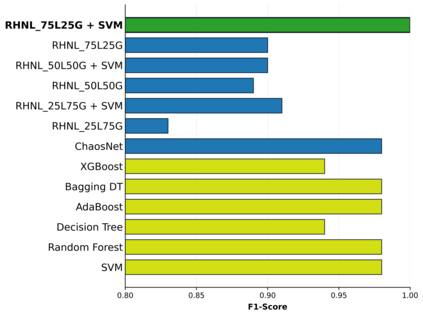
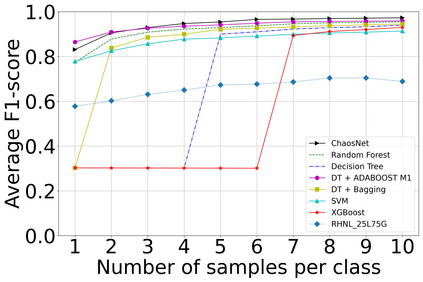
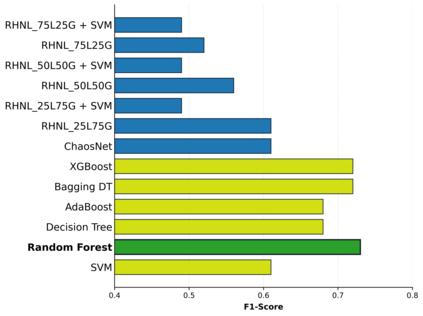
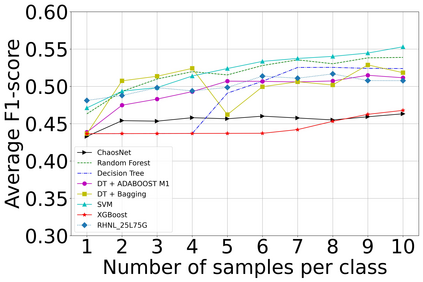
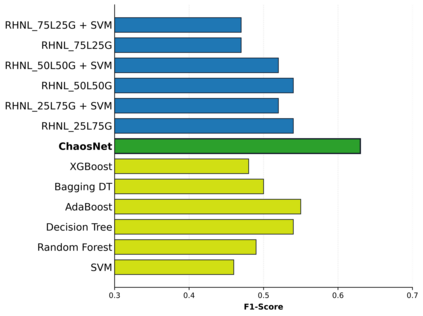
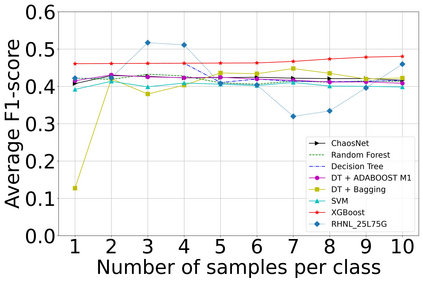
Forest fires are among the most dangerous and unpredictable natural disasters worldwide. Forest fire can be instigated by natural causes or by humans. They are devastating overall, and thus, many research efforts have been carried out to predict whether a fire can occur in an area given certain environmental variables. Many research works employ Machine Learning (ML) and Deep Learning (DL) models for classification; however, their accuracy is merely adequate and falls short of expectations. This limit arises because these models are unable to depict the underlying nonlinearity in nature and extensively rely on substantial training data, which is hard to obtain. We propose using Neurochaos Learning (NL), a chaos-based, brain-inspired learning algorithm for forest fire classification. Like our brains, NL needs less data to learn nonlinear patterns in the training data. It employs one-dimensional chaotic maps, namely the Generalized L\"uroth Series (GLS), as neurons. NL yields comparable performance with ML and DL models, sometimes even surpassing them, particularly in low-sample training regimes, and unlike deep neural networks, NL is interpretable as it preserves causal structures in the data. Random Heterogenous Neurochaos Learning (RHNL), a type of NL where different chaotic neurons are randomnly located to mimic the randomness and heterogeneity of human brain gives the best F1 score of 1.0 for the Algerian Forest Fires Dataset. Compared to other traditional ML classifiers considered, RHNL also gives high precision score of 0.90 for Canadian Forest Fires Dataset and 0.68 for Portugal Forest Fires Dataset. The results obtained from this work indicate that Neurochaos Learning (NL) architectures achieve better performance than conventional machine learning classifiers, highlighting their promise for developing more efficient and reliable forest fire detection systems.
翻译:暂无翻译




相关内容



 微信扫码咨询专知VIP会员