

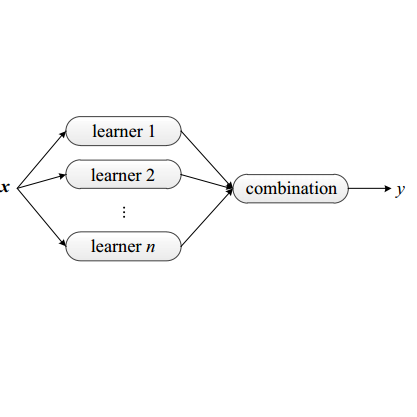
Background: Machine learning (ML) model composition is a popular technique to mitigate shortcomings of a single ML model and to design more effective ML-enabled systems. While ensemble learning, i.e., forwarding the same request to several models and fusing their predictions, has been studied extensively for accuracy, we have insufficient knowledge about how to design energy-efficient ensembles. Objective: We therefore analyzed three types of design decisions for ensemble learning regarding a potential trade-off between accuracy and energy consumption: a) ensemble size, i.e., the number of models in the ensemble, b) fusion methods (majority voting vs. a meta-model), and c) partitioning methods (whole-dataset vs. subset-based training). Methods: By combining four popular ML algorithms for classification in different ensembles, we conducted a full factorial experiment with 11 ensembles x 4 datasets x 2 fusion methods x 2 partitioning methods (176 combinations). For each combination, we measured accuracy (F1-score) and energy consumption in J (for both training and inference). Results: While a larger ensemble size significantly increased energy consumption (size 2 ensembles consumed 37.49% less energy than size 3 ensembles, which in turn consumed 26.96% less energy than the size 4 ensembles), it did not significantly increase accuracy. Furthermore, majority voting outperformed meta-model fusion both in terms of accuracy (Cohen's d of 0.38) and energy consumption (Cohen's d of 0.92). Lastly, subset-based training led to significantly lower energy consumption (Cohen's d of 0.91), while training on the whole dataset did not increase accuracy significantly. Conclusions: From a Green AI perspective, we recommend designing ensembles of small size (2 or maximum 3 models), using subset-based training, majority voting, and energy-efficient ML algorithms like decision trees, Naive Bayes, or KNN.
翻译:暂无翻译




相关内容




 微信扫码咨询专知VIP会员