

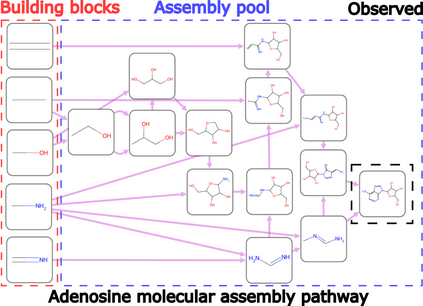
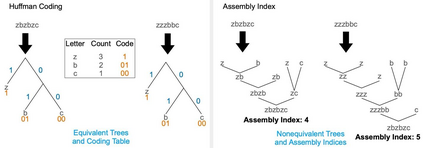
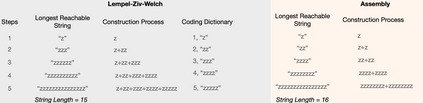
Assembly theory (AT) quantifies selection using the assembly equation and identifies complex objects that occur in abundance based on two measurements, assembly index and copy number, where the assembly index is the minimum number of joining operations necessary to construct an object from basic parts, and the copy number is how many instances of the given object(s) are observed. Together these define a quantity, called Assembly, which captures the amount of causation required to produce objects in abundance in an observed sample. This contrasts with the random generation of objects. Herein we describe how AT's focus on selection as the mechanism for generating complexity offers a distinct approach, and answers different questions, than computational complexity theory with its focus on minimum descriptions via compressibility. To explore formal differences between the two approaches, we show several simple and explicit mathematical examples demonstrating that the assembly index, itself only one piece of the theoretical framework of AT, is formally not equivalent to other commonly used complexity measures from computer science and information theory including Shannon entropy, Huffman encoding, and Lempel-Ziv-Welch compression. We also include proofs that assembly index is not in the same computational complexity class as these compression algorithms and discuss fundamental differences in the ontological basis of AT, and assembly index as a physical observable, which distinguish it from theoretical approaches to formalizing life that are unmoored from measurement.
翻译:暂无翻译











相关内容



 微信扫码咨询专知VIP会员