

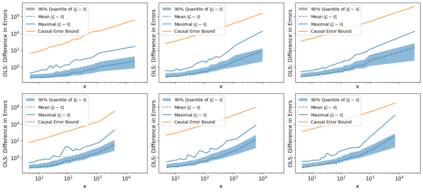
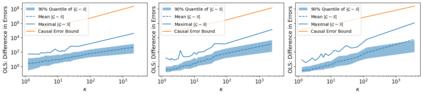
Despite the increasing relevance of forecasting methods, causal implications of these algorithms remain largely unexplored. This is concerning considering that, even under simplifying assumptions such as causal sufficiency, the statistical risk of a model can differ significantly from its \textit{causal risk}. Here, we study the problem of \textit{causal generalization} -- generalizing from the observational to interventional distributions -- in forecasting. Our goal is to find answers to the question: How does the efficacy of an autoregressive (VAR) model in predicting statistical associations compare with its ability to predict under interventions? To this end, we introduce the framework of \textit{causal learning theory} for forecasting. Using this framework, we obtain a characterization of the difference between statistical and causal risks, which helps identify sources of divergence between them. Under causal sufficiency, the problem of causal generalization amounts to learning under covariate shifts, albeit with additional structure (restriction to interventional distributions under the VAR model). This structure allows us to obtain uniform convergence bounds on causal generalizability for the class of VAR models. To the best of our knowledge, this is the first work that provides theoretical guarantees for causal generalization in the time-series setting.
翻译:尽管预测方法的相关性日益提高,但这些算法的因果关系基本上仍未得到探讨。这涉及到,即使根据诸如因果充分性等简化假设,模型的统计风险也与其\ textit{causal 风险} 有很大差异。在这里,我们研究了从观察到干预分布的一般化问题,即从观察到干预分布的预测。我们的目标是找到问题的答案:在预测统计协会方面自动递减模式相对于其在干预下预测的能力的效力如何?为此,我们引入了用于预测的\textit{causal 学习理论框架。我们利用这一框架,对统计风险和因果风险之间的差异进行了定性,这有助于找出它们之间的差异根源。在因果充分性方面,因果概括化问题相当于在变异性变化中学习,尽管在补充结构下(限制在VAR模式下干预分布)如何有效?这一结构使我们能够在统计协会的因果关系上取得统一的趋同,用于预测。我们利用这一框架,我们获得了统计风险和因果性风险之间的差别,从而有助于查明它们之间的差异。在因果性、因果性变化中学习,尽管增加了结构结构(限制在VAR模式下的干预分布)。这一结构下,这样结构使我们得以获得关于VAR理论模型中第一种理论序列中的最佳知识。




相关内容




 微信扫码咨询专知VIP会员