

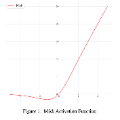
Physics-informed neural networks (PINNs) have emerged as a promising approach for solving complex fluid dynamics problems, yet their application to fluid-structure interaction (FSI) problems with moving boundaries remains largely unexplored. This work addresses the critical challenge of modeling FSI systems with moving interfaces, where traditional unified PINN architectures struggle to capture the distinct physics governing fluid and structural domains simultaneously. We present an innovative Eulerian-Lagrangian PINN architecture that integrates immersed boundary method (IBM) principles to solve FSI problems with moving boundary conditions. Our approach fundamentally departs from conventional unified architectures by introducing domain-specific neural networks: an Eulerian network for fluid dynamics and a Lagrangian network for structural interfaces, coupled through physics-based constraints. Additionally, we incorporate learnable B-spline activation functions with SiLU to capture both localized high-gradient features near interfaces and global flow patterns. Empirical studies on a 2D cavity flow problem involving a moving solid structure show that while baseline unified PINNs achieve reasonable velocity predictions, they suffer from substantial pressure errors (12.9%) in structural regions. Our Eulerian-Lagrangian architecture with learnable activations (EL-L) achieves better performance across all metrics, improving accuracy by 24.1-91.4% and particularly reducing pressure errors from 12.9% to 2.39%. These results demonstrate that domain decomposition aligned with physical principles, combined with locality-aware activation functions, is essential for accurate FSI modeling within the PINN framework.
翻译:物理信息神经网络(PINNs)已成为解决复杂流体动力学问题的一种有前景的方法,但其在具有移动边界的流固耦合(FSI)问题中的应用仍鲜有探索。本研究针对具有移动界面的FSI系统建模这一关键挑战,传统统一的PINN架构难以同时捕捉流体与结构域中不同的物理规律。我们提出了一种创新的欧拉-拉格朗日PINN架构,该架构集成了浸没边界法(IBM)原理,以求解具有移动边界条件的FSI问题。我们的方法从根本上区别于传统的统一架构,引入了针对特定域的神经网络:一个用于流体动力学的欧拉网络和一个用于结构界面的拉格朗日网络,两者通过基于物理的约束进行耦合。此外,我们结合了可学习的B样条激活函数与SiLU,以捕捉界面附近局部高梯度特征及全局流动模式。在涉及移动固体结构的二维空腔流动问题的实证研究中,基准统一PINNs虽能获得合理的速度预测,但在结构区域存在显著的压力误差(12.9%)。我们提出的具有可学习激活函数的欧拉-拉格朗日架构(EL-L)在所有指标上均表现出更优性能,将精度提高了24.1%至91.4%,尤其将压力误差从12.9%降低至2.39%。这些结果表明,在PINN框架内,结合物理原理的域分解与局部感知的激活函数对于精确的FSI建模至关重要。




相关内容

 微信扫码咨询专知VIP会员