

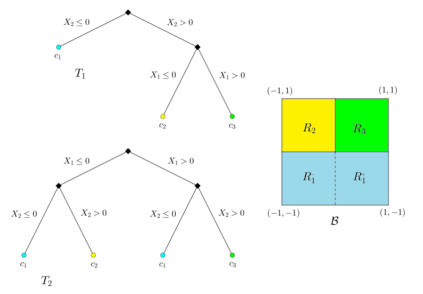
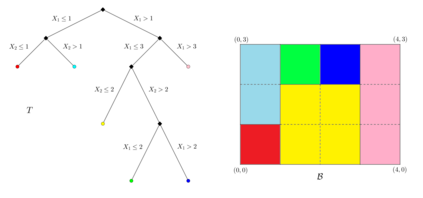
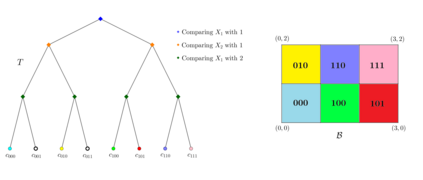
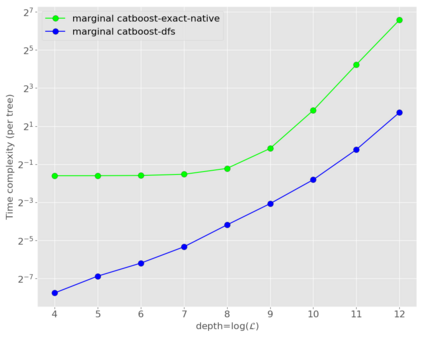
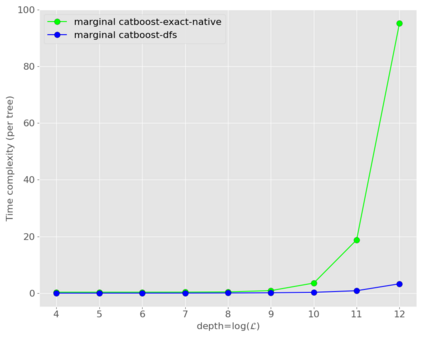
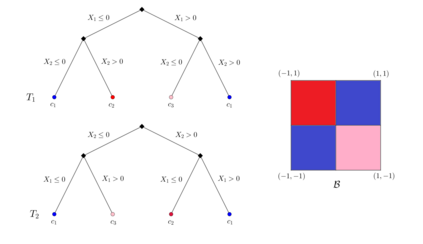
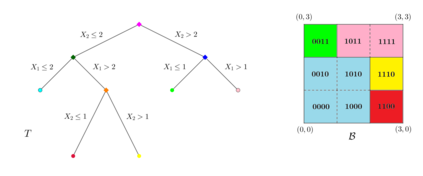
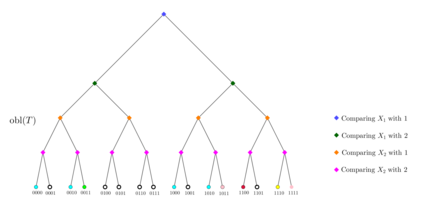
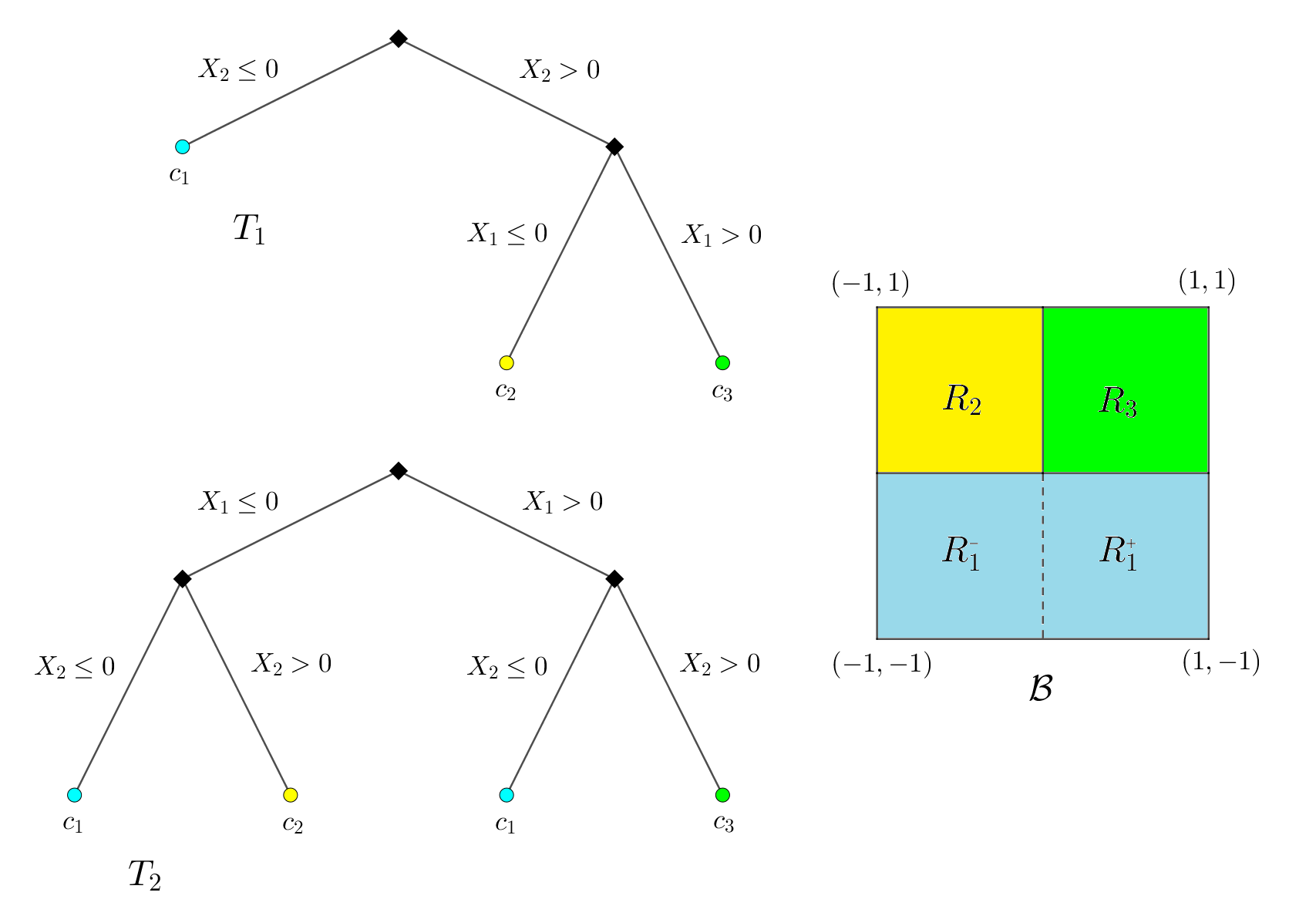
Due to their power and ease of use, tree-based machine learning models, such as random forests and gradient-boosted tree ensembles, have become very popular. To interpret them, local feature attributions based on marginal expectations, e.g. marginal (interventional) Shapley, Owen or Banzhaf values, may be employed. Such methods are true to the model and implementation invariant, i.e. dependent only on the input-output function of the model. We contrast this with the popular TreeSHAP algorithm by presenting two (statistically similar) decision trees that compute the exact same function for which the "path-dependent" TreeSHAP yields different rankings of features, whereas the marginal Shapley values coincide. Furthermore, we discuss how the internal structure of tree-based models may be leveraged to help with computing their marginal feature attributions according to a linear game value. One important observation is that these are simple (piecewise-constant) functions with respect to a certain grid partition of the input space determined by the trained model. Another crucial observation, showcased by experiments with XGBoost, LightGBM and CatBoost libraries, is that only a portion of all features appears in a tree from the ensemble. Thus, the complexity of computing marginal Shapley (or Owen or Banzhaf) feature attributions may be reduced. This remains valid for a broader class of game values which we shall axiomatically characterize. A prime example is the case of CatBoost models where the trees are oblivious (symmetric) and the number of features in each of them is no larger than the depth. We exploit the symmetry to derive an explicit formula, with improved complexity and only in terms of the internal model parameters, for marginal Shapley (and Banzhaf and Owen) values of CatBoost models. This results in a fast, accurate algorithm for estimating these feature attributions.
翻译:暂无翻译




相关内容




 微信扫码咨询专知VIP会员