

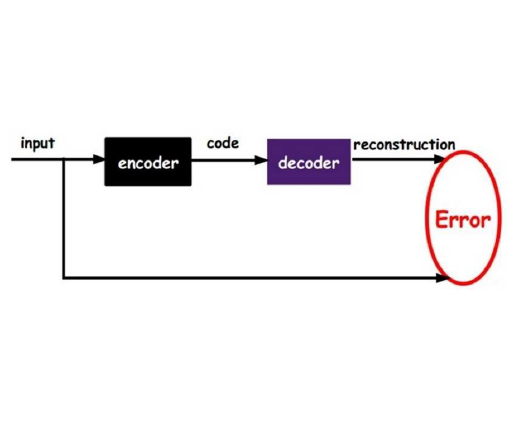
In the autoencoder based anomaly detection paradigm, implementing the autoencoder in edge devices capable of learning in real-time is exceedingly challenging due to limited hardware, energy, and computational resources. We show that these limitations can be addressed by designing an autoencoder with low-resolution non-volatile memory-based synapses and employing an effective quantized neural network learning algorithm. We propose a ferromagnetic racetrack with engineered notches hosting a magnetic domain wall (DW) as the autoencoder synapses, where limited state (5-state) synaptic weights are manipulated by spin orbit torque (SOT) current pulses. The performance of anomaly detection of the proposed autoencoder model is evaluated on the NSL-KDD dataset. Limited resolution and DW device stochasticity aware training of the autoencoder is performed, which yields comparable anomaly detection performance to the autoencoder having floating-point precision weights. While the limited number of quantized states and the inherent stochastic nature of DW synaptic weights in nanoscale devices are known to negatively impact the performance, our hardware-aware training algorithm is shown to leverage these imperfect device characteristics to generate an improvement in anomaly detection accuracy (90.98%) compared to accuracy obtained with floating-point trained weights. Furthermore, our DW-based approach demonstrates a remarkable reduction of at least three orders of magnitude in weight updates during training compared to the floating-point approach, implying substantial energy savings for our method. This work could stimulate the development of extremely energy efficient non-volatile multi-state synapse-based processors that can perform real-time training and inference on the edge with unsupervised data.
翻译:暂无翻译




相关内容



 微信扫码咨询专知VIP会员